In the wake of Charlie Kirk’s assassination, the internet has been decidedly split. One side can’t stop praising Kirk’s name, while the other celebrates like demons dancing on a grave. These two groups don’t live in the same algorithmic reality. One only ever saw Kirk’s best, the other, only his worst, or at least what people edited to look like his worst.
Then there’s the bigger crowd: the confused middle. Many who had never even heard the name “Charlie Kirk” before September 10. And now they’re asking themselves, who was this man that could provoke such opposing views? Was he a villain? Was he a hero?
Like many conservatives, I’ve tried to show Charlie in a fair, unedited light. Some people have accepted the truth, some refuse to listen, and still others have considered the evidence yet remain uneasy about the character and platform of this self-professed Christ follower. If that’s you—the uneasy one—this is for you.
First, we’ll unpack four of the most viral soundbites fueling the case against Charlie Kirk. Then we’ll tackle the deeper heart issue that keeps us from really hearing each other.
Claim 1: Kirk used the racial slur, “chink” in an argument.
Response: This. Never. Happened.
Kirk, did get in a heated exchange with a liberal media commentator by the name of Cenk Uygur (pronounced “Chenk”).
Claim 2: Kirk said, “If I see a Black pilot, I’m going to be like, boy, I hope he’s qualified.” – The Charlie Kirk Show, January 2024
Response: Yes, he said this. And no, Kirk did not smear his Christian card in doing so.
This comment was not about the skill and ability of black pilots, surgeons, or professors. It was about DEI policies which push for hiring based on gender and race, not merit. Such policies create a cloud of doubt among citizens who are left with no way of knowing whether a person of color received their position because of their skill set or because of their skin tone.
And, as Kirk also said, nobody wants to have that question lingering in their mind (for moral and safety reasons). It causes fear among the public, and it diminishes the work and talent of people of color who are excellent at their jobs. Charlie later offered further clarification during an interview with Megyn Kelly saying, “Of course I believe anybody of any skin color can become a qualified pilot.”
The whole DEI debate escalated due to a mix-up over a 2021 United Airlines announcement which stated that United planned to train at least 5,000 new pilots at its Aviate Academy by 2030, half of whom would be women or people of color. Plenty of folks cheered the move, but others panicked, thinking United would start hiring unqualified pilots just to hit diversity quotas. In reality, this initiative was about training, not hiring—and every pilot still has to pass the FAA’s famously tough licensing requirements.
Claim #3: Charlie Kirk said the Civil Rights Act was a mistake.
Response: This claim is false in the sense that Kirk meant the entire Civil Rights Act was a mistake, which this claim implies. What he said was:
“I have a very, very radical view on this, but I can defend it, and I’ve thought about it. We made a huge mistake when we passed the Civil Rights Act in the 1960s.” America Fest 2023.
There is a big difference between suggesting an entire Act was wrong and should be repealed vs. saying mistakes were made in its writing. If you spend even just a few minutes – yes, minutes – listening to Kirk’s platform and messaging, it is obvious he is referring to the latter.
For example, when asked about this quote on a college campus, Charlie replied:
“Parts of the civil rights act were great, but the way it’s now being implemented to force men in female bathrooms, to push forward the trans agenda… the intent and the law are two different things. So, the intent was noble, which was to say that no American can be not allowed into a place of business based on the color of their skin or their ethnic heritage. (I’m) totally in agreement with that. That’s not what the law only did…”” it’s too broad, too wide, and it’s now doing a lot of damage to the country and its being used well beyond its original intent.”
On another occasion, a student asked Kirk, “If you had the opportunity, would you get rid of the Civil Rights Act?”
Charlie answered: “No, I think you should have a one-page bill that says that racial discrimination based on race is illegal and will not be tolerated in the United States of America… Believe it or not, the Civil Rights Act is now being used to keep men playing in women’s sports. So, the Civil Rights Act was used to help black America originally, totally get that. But now, the way it was written, is that any claim of identification, so if someone says, “I am a woman,” therefore, I can compete in your volleyball team. They come in with a civil rights claim…
In short, ending segregation and Jim Crow = good. Biological men in women’s bathrooms = bad. The Civil Rights Act is written in such a way that you can use it to defend both, which is a problem if you don’t want men in women’s sports or locker rooms.
Claim #4:
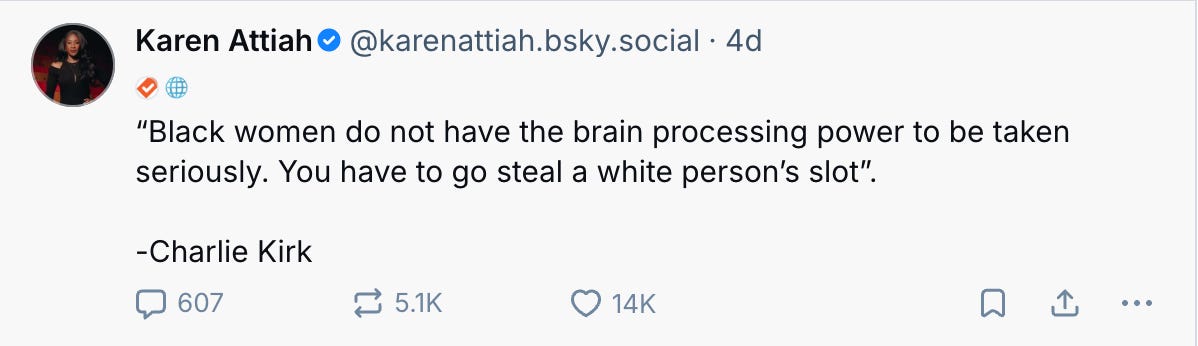
Response: This is a misquote created by Karen Attiah who was fired by the Washington Post shortly after publishing it. Attiah altered Kirk’s original quote (below), framing him as both racist and misogynistic toward all black women.
The original quote:
“If we would have said that Joy Reid and Michelle Obama and Sheila Jackson Lee and Ketanji Brown Jackson were affirmative action picks, we would have been called racists. Now they’re coming out and they’re saying it for us … You do not have the brain processing power to otherwise be taken really seriously. You had to go steal a white person’s slot to go be taken somewhat seriously….”- The Charlie Kirk Show, 13 July 2023
Response: Charlie blew this one.
Don’t get me wrong, Charlie’s pushback on the policies these women support was mostly on target. But that doesn’t give anyone the right to take cheap shots at their intelligence or intentions. I wish I could have found a follow-up from Charlie admitting how he mishandled the topic that day, but I couldn’t.
However, it’s important to note that these comments didn’t represent how Charlie felt about “all black women”. He was calling out four specific women he strongly disagreed with—and in this moment, he crossed the line into plain disrespect.
I’m not saying this to cover for Charlie—he doesn’t need me to. I’m saying it because when people think racist comments get made and then shrugged off, it only adds to the hurt and cranks up the divide.
The Heart Problem
I’ve had some hard talks with Black friends about the pain caused by Kirk’s alleged comments—and by the wave of support he still seems to have from millions. For many in the Black community, that kind of open backing feels like an endorsement of the racism and misogyny they believe he represented.
Those conversations taught me two big lessons I want to pass along—hoping they’ll help you, too.
Lesson 1: Are We Defending, Correcting, or Caring?
When a friend is hurting because someone used a racist slur, their first need is support. They want to know I’m standing with them.
But what if I’m pretty sure the hurtful comment never actually happened—or was taken out of context? My instinct is to fix it: “Good news—what you heard isn’t true. You don’t have to be hurt.”
I mean it as a way to bring truth and maybe take away some pain. But to them, it can sound different—more like, “You’re wrong, and here’s why,” instead of, “I see your hurt, and I care.”
That gap gets even wider on social media where quick posts and replies easily sound like we’re just picking sides. So to my fellow Charlie supporters: when you try to correct misinformation, remember how it can land. And to my Black brothers and sisters: know that when I speak up, my aim isn’t to “clear” Charlie’s name—it’s to help ease the pain you’re feeling.
Lesson 2: The Nation isn’t Done Healing
When I— a white woman who didn’t grow up in the U.S.— hear the statement, “If I see a Black pilot, I’m going to be like, boy, I hope he’s qualified,” I recognize it as a jab at DEI policies. Because, for many conservatives “DEI” isn’t short for “diversity, equity, and inclusion,” but for “hiring based on race or sex instead of skill.”
When a black person hears a statement like this out of context, they are bringing a completely different history to the table than me. One where black people were considered so intellectually inferior that they were just slightly above animals. One where their cruel mistreatment was justified by white people because it was believed they didn’t feel as much pain.
With that backdrop, it’s no shock that many Black Americans hear a statement like this and assume racism. Instead of scolding them or accusing them of a “victim mentality,” we need patience, kindness, and grace. They carry a wound that we, as a nation, have not done a good job healing.
White America may have moved on—at least on the polite surface. And yes, many Black Americans have moved forward too. But plenty still bear the marks of generations past: the silence, the stories from parents and grandparents about white cruelty that can’t simply be erased in the name of progress.
Some wounds run so deep that before we can move forward together, we first have to look back. We can’t undo history’s wrongs, but we can offer our shoulders, our ears, and our hearts to our Black brothers and sisters. For how long? For as long as they need.
That’s what it means to live out the second greatest commandment: to love our neighbors as ourselves.
Saint or Sinner?
Charlie Kirk brought excellence to the fields of political commentary, evangelism, activism, and debate. His courage, faith, and entrepreneurial drive were undeniable, and his voice carried the gospel to millions. That’s the legacy worth remembering—not a few moments of insensitivity or rudeness.
But Charlie was never the hero of his own story. He knew it. We should too. Charlie Kirk was not our savior. Like every one of us, he was a sinner—redeemed not by perfection but by grace. And if flawless lives were the price of honor, none of us would deserve to be remembered at all.